



Main · CORTEC equipment ·
Calculate cost

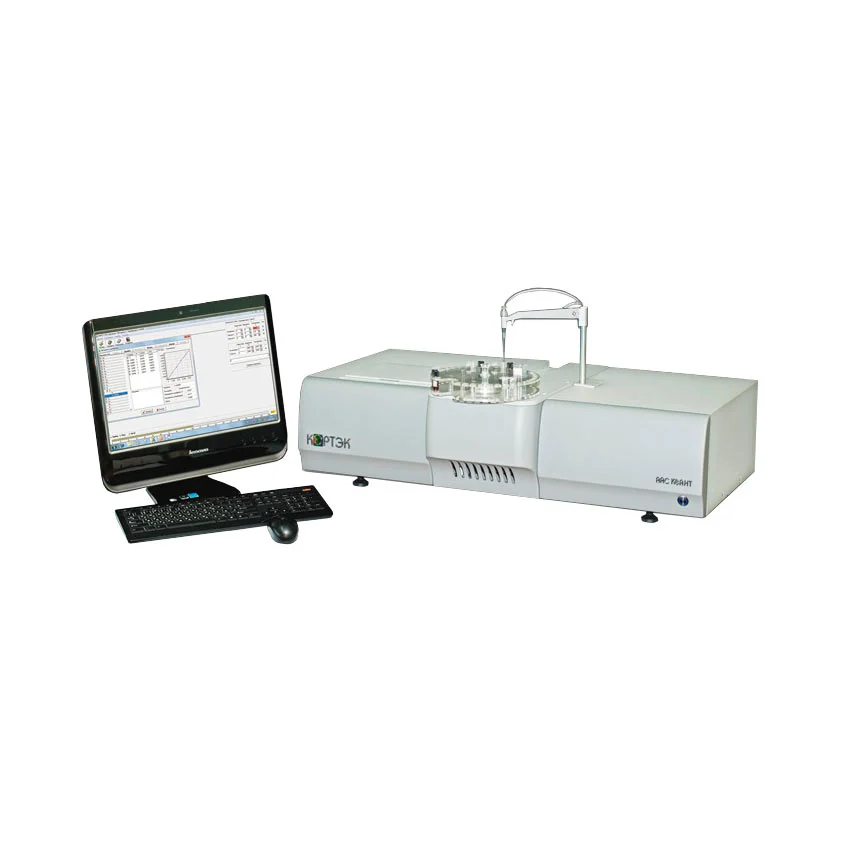
Atomic absorption spectrometer with electrothermal atomization CORTEC KVANT.Z
Name
E-mail
Phone number
Calculate cost
Manager will contact you and answer all your questions
By clicking the button, you agree to the terms of the privacy policy
Contact me
Name
E-mail
Phone number
Contact me
Manager will contact you and answer all your questions
By clicking the button, you agree to the terms of the privacy policy
Atomic absorption spectrometer with electrothermal atomization CORTEC KVANT.Z
Calculate cost
Contact me
Electrothermal sample atomization in a rapidly heated graphite tube furnace, with spectral interference correction using the inverse Zeeman effect.
Designed for the quantitative determination of elements in liquid samples of various origins and compositions at the ng/L (ppt) level.
Main applications include environmental monitoring, sanitary and hygienic testing, food testing, biotechnology, medicine, geology, metallurgy, and scientific research.
Versions
- Single-lamp spectrometer with a built-in automatic dispenser
- Spectrometer with an automatically adjusted six-lamp turret and a built-in automatic dispenser
Specifications
Spectral interference correction based on the inverse Zeeman effect, with a dual-beam, dual-channel atomic absorption measurement algorithm. Resonant radiation sources are LT-6M hollow-cathode spectral lamps. Lamp power supply - pulsed, synchronized with the magnetic field in the analytical cell
- Spectral range, nm: 185 ÷ 1100
- Optical density measurement range, B: 0 ÷ 3
- Duration of one measurement, sec: 30
- Dimensions, mm: 860 x 455 x 210
- Weight, kg: no more than 67
Ability to operate with a BALAST in a fast-heating graphite furnace
Optical system
- Monochromator with holographic diffraction grating and automatic wavelength adjustment.
- Photodetector - broadband photodiode, providing high sensitivity.
Atomizer
- Graphite furnace with pyrolytic coating
- Furnace heating rate, degrees/sec: 10,000
- Protective gas: argon
- Argon flow rate, l/min: no more than 0.5
- Dosing volume, µl: 5 ÷ 30
The rapid heating of the graphite furnace ensures separation in time between the atomization and dissipation of atomic vapor from the analytical volume. As a result, the signal amplitude depends only on the amount of the element in the sample and is independent of matrix components and transfer parameters. The furnace heating program lasts 30-40 s, ensuring performance close to that of flame atomic absorption spectrometry.
The spectrometer is equipped with a local cooling system
Spectral interference correction
To correct spectral interference (background signal absorption), the graphite furnace is placed in an alternating magnetic field generated by an electromagnet powered by line voltage. A dual-channel algorithm is implemented, and the analytical signal is independent of background non-atomic absorption. The dual-channel data processing algorithm ensures that the analytical signal is independent of the intensity drift of the resonant radiation source and the sensitivity of the photodetector, as in dual-beam spectrophotometers.
Spectrometer Control
Spectrometer control, status diagnostics, processing, display, and storage of analytical data are performed by a personal computer using a specialized software package.